Published in BioLab Business magazine, Spring 2024
VIDO InterVac: helping to build a healthier world
Canadian vaccine and infectious disease organization, and centre for pandemic research, continuously working to protect communities all over the world from harmful pathogens
There’s no questioning the severity of the impacts caused by the COVID-19 global pandemic – a virus that spread throughout just about every community in every country on the planet. It’s indiscriminate brutality wreaked havoc worldwide, resulting in closed borders, a suffocated global supply chain, and hundreds of millions of confirmed infections that involved cases ranging from moderate sickness to death. In short, the pandemic disrupted and, in some instances, devastated life as we knew it. In light of this – in an attempt to limit or prevent the spread of the world’s next superbug – VIDO-Intervac, Canada’s national pandemic research centre, is dedicated to and focused on vaccine development and garnering a better understanding of the world’s deadliest pathogens. In fact, according to Dr. Volker Gerdts, VIDO’s CEO, it’s a passion within the organization that drives he and his colleagues toward their goals every day.
“VIDO is one of the most unique organizations in Canada, and the world,” he asserts with pride. “Everyone within the organization is dedicated to addressing real world problems related to viruses and diseases. We have obviously been incredibly involved in the COVID-19 side of research and vaccine development. However, a great deal of our focus is on dissecting and understanding in detail emerging diseases or new diseases that have the potential to cause big problems. It’s incredibly important work that everyone does here at VIDO, whether researching diseases and developing vaccines to address issues within animals or humans, in order to keep everyone safe and healthy.”
Canada’s vaccine research and development hub
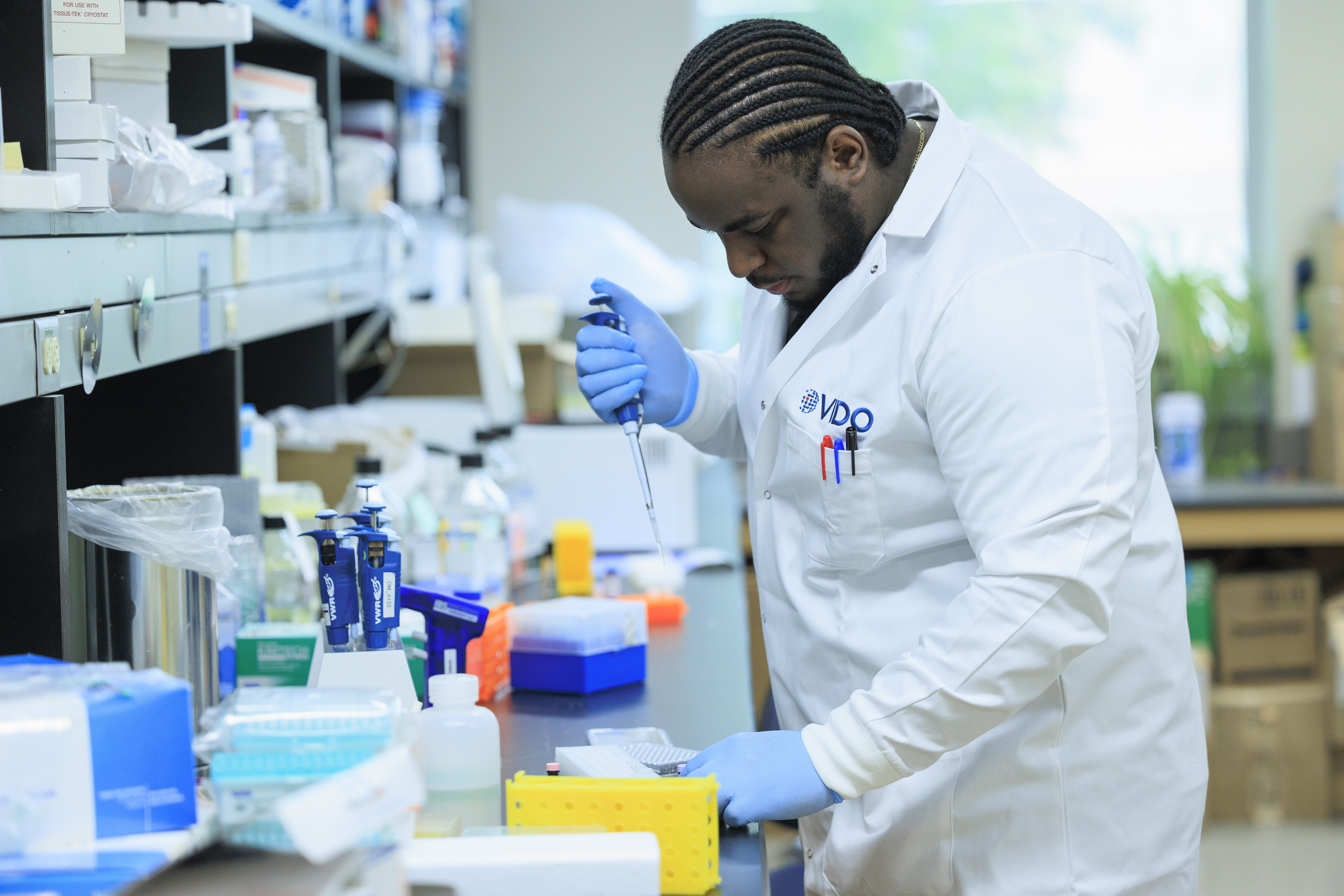
The organization operates Canada’s largest high-containment lab. The Vaccine Development Centre, located in Saskatoon, Saskatchewan, is a three-level facility capable of handling Risk Group 3 pathogens – some of the deadliest in the world. It’s a facility that came in very handy during the onset of the COVID-19 global pandemic, enabling VIDO to work with more than 100 different organizations from all around the world to conduct testing on vaccine candidates, accelerating development for use on humans. It’s a contribution that Gerdts says VIDO was thrilled to make toward addressing the global crisis. And, he says that’s something that also helped to reenforce the value that the organization offers.
“What we all experienced during the pandemic taught everyone, scientists and researchers included, the extreme importance of speed when it comes to the development of these technologies. And, it’s also shown us what we’re capable of achieving. Normally, the development of a vaccine for humans prior to the pandemic would take 10 to 15 years to gain approval and licensing. And for animal vaccines, it regularly takes five to seven years. But the pandemic showed us all that, with the availability of necessary resources, we’re all able to work much faster toward development and approval.”
Supporting technology
It might go without saying, but Gerdts stresses the critical nature of the continuous contribution to vaccine research and development made by existing and merging technologies. He says that none of these innovations and life-saving advances would ever be made without it, adding that much, if not all, of his daily work would no longer be possible to execute if it weren’t for technology.
“We rely on advances in technology,” he says. “It’s our support and the enabler for the ideas that we generate. Nothing would be possible without it. It provides the necessary infrastructure that we need to conduct our research and testing. And now, we operate a vaccine manufacturing facility allowing us to make vaccines for both humans and animals in one facility, which is really unique, tying into containment as well. So, we’ve now centralized research, early discovery and development all in one location. It’s an incredible environment for researchers to do their work within, with access to all of the latest cutting-edge technologies and machines.”
People power
Gerdts goes on to explain that the combination of state-of-the-art facilities, housing the very latest in advanced technology, is enough to make VIDO a world-class organization, allowing it to remain nimble and agile in the face of challenges. However, the underpinning of everything that it does, from research through to development and testing, is the group of likeminded, talented individuals that it has working beneath its roof.
“As an organization, we need to be really quick and willing and able to jump from one problem or challenge to the next, while finding solutions along the way,” he says. “What that means, however, is that the people within the organization become incredibly important – teams that are willing to switch projects and who are open to close collaboration and providing their expertise wherever it’s needed. We have the very best working here at VIDO, who all fit these criteria and work every day with a passion and dedication to what we’re trying to achieve. It’s the most unique aspect of the organization, and the element of the operation that keeps us moving forward.”
Exciting work
Currently, among a whole range of projects that the organization has undertaken, Gerdts speaks excitedly about its work involving prions, which are abnormal pathogenic agents that are transmissible and able to induce abnormal folding of specific normal cellular proteins called prion proteins. It’s groundbreaking work that he believes could yield dramatic results.
“We’re doing some really interesting and exciting research and work around prions,” he says. “Bovine Spongiform Encephalopathy (BSE), or Mad Cow Disease as it’s known to most, almost decimated Canada’s livestock industry a few years ago, costing billions of dollars. Now, we’ve seen prion diseases infiltrate wildlife species, in deer and elk. This is scary on its own. But what’s worse is that these prions seem to have evolved and could potentially, one day, jump from one animal to another, and perhaps into humans. It’s only a matter of time before this happens, posing potentially devastating consequences for large populations of the planet. And so, we’re doing a lot of research on prions, to understand them better in order to preserve our health.”
Enhanced pandemic preparedness
Gerdts says that this is a critical time for vaccine research and development. He suggests that it’s time for organizations all across the country, and around the world, to increase collaboration and information sharing in order to get ahead of the next global health crisis. And, he assures that intense research and vaccine development will remain the focus of VIDO long into the future in efforts to safeguard the world.
“It’s really important to recognize the need for better pandemic preparedness. In fact, it’s certainly more important now than it ever has been before. Continued research on infectious diseases, and funding to support this research, is absolutely critical to the future of life on the planet. When we really think about it, the mortality rate related to the COVID-19 pandemic was not that bad compared to what could result from other viral pandemics. And, that’s the point – without this type of specified research, we’d have no idea at all what the next pandemic might be until long after it spread. We’d have no idea about the possible mortality rate. That’s why we need organizations like VIDO to ensure that we maintain a state of preparedness in case of the worst.”
 Sean Tarry Writes.